
VCM thought leadership
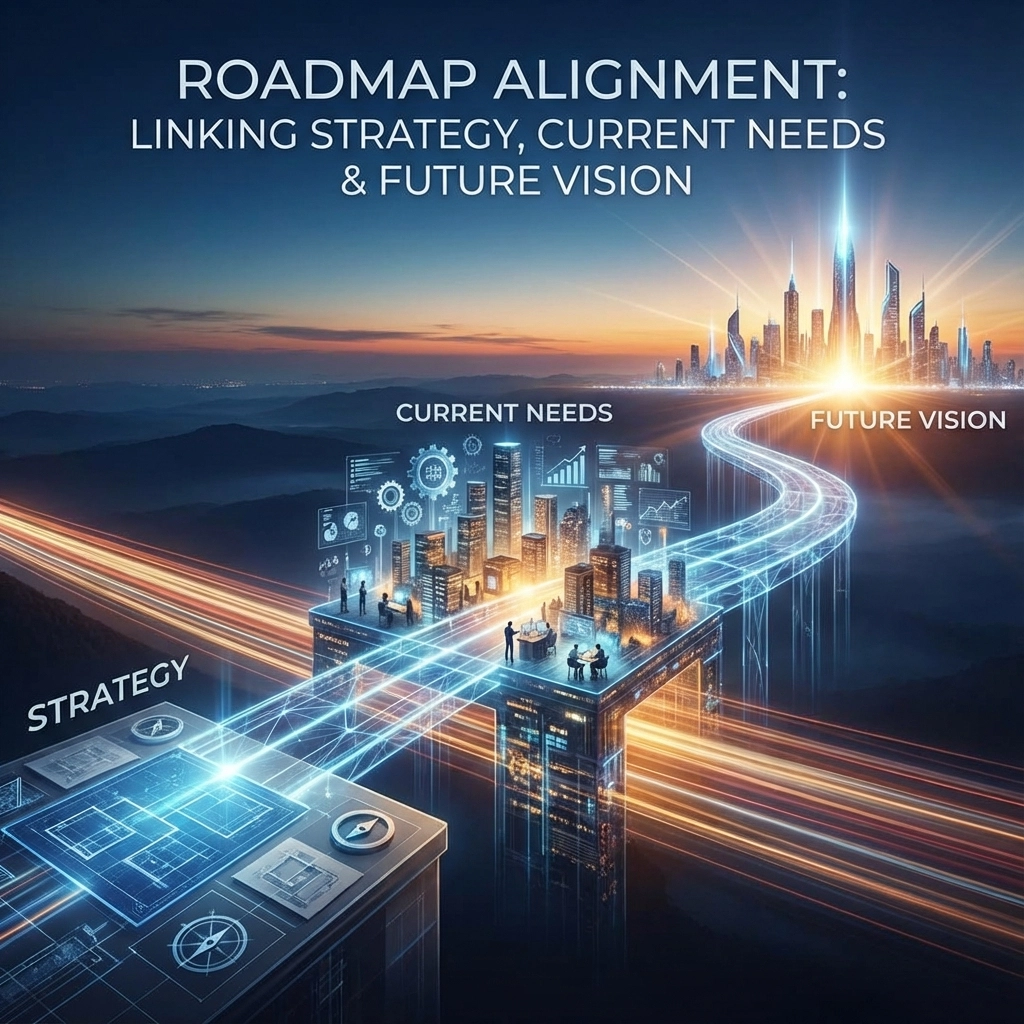
Roadmap Alignment: Linking Strategy, Current Needs & Future Vision
How often do you find your team working on initiatives that feel disconnected from your actual business priorities? You're not alone. Research shows that 59% of companies struggle to connect their strategic goals with daily execution. The gap between what leadership envisions and what teams actually deliver creates inefficiency, frustration, and missed opportunities.
At Value Chain Management, we see this challenge across every sector we work with. CEOs have clear visions for growth, but their operational teams are stuck firefighting today's problems. Marketing pushes for customer-centric initiatives while IT focuses on system upgrades. Finance demands cost reduction while sales needs investment in new capabilities.
The solution isn't choosing sides: it's building roadmaps that genuinely align strategy with current realities and future ambitions.
Why Most Roadmaps Fail to Connect the Dots
Traditional roadmaps often exist in isolation. They're either too strategic (full of aspirational goals with no clear path) or too tactical (endless feature lists with no strategic rationale). Neither approach works because they ignore the fundamental reality of business: you need to satisfy today's demands while building tomorrow's capabilities.
We've worked with manufacturing companies whose "digital transformation roadmaps" ignored their immediate supply chain bottlenecks. We've seen tech startups with roadmaps focused entirely on new features while their customer retention rates plummeted. In both cases, the roadmap became a planning document rather than a strategic execution tool.
The most effective roadmaps we develop treat alignment as a three-dimensional challenge: connecting high-level strategy with immediate operational needs and long-term market positioning.

The Three-Pillar Alignment Framework
Strategic Anchor Points
Your roadmap needs clear strategic anchor points: specific, measurable objectives that directly support your company's vision. These aren't vague aspirations like "become more customer-focused." They're concrete outcomes like "reduce customer onboarding time from 14 days to 3 days" or "increase recurring revenue from 40% to 65% of total revenue within 18 months."
We start every roadmapping engagement by identifying 3-5 strategic anchor points that leadership genuinely commits to achieving. These become the filter for every subsequent decision: does this initiative move us closer to these specific outcomes?
Current State Assessment
Strategy without situational awareness is wishful thinking. Our roadmapping process includes comprehensive assessment of your current capabilities, constraints, and market position. This means honest evaluation of your technology infrastructure, team skills, financial capacity, and competitive pressures.
For a mid-sized logistics company we worked with, their strategic goal was expanding into new geographic markets. But our current state assessment revealed their existing warehouse management system couldn't handle current volume efficiently. The roadmap prioritized operational optimization before expansion: saving them from scaling their problems.
Future Vision Integration
The most sophisticated element involves mapping tactical initiatives to long-term market positioning. This requires understanding not just where you want to be in 12 months, but how today's decisions position you for the market conditions you'll face in 2-3 years.
Consider automation investments. The immediate need might be reducing manual processing costs. But the future vision consideration asks: how does this automation capability position us when our competitors face the same cost pressures? Does it create sustainable competitive advantage or just operational parity?
Practical Implementation: The VCM Approach
Phase 1: Strategic Clarification
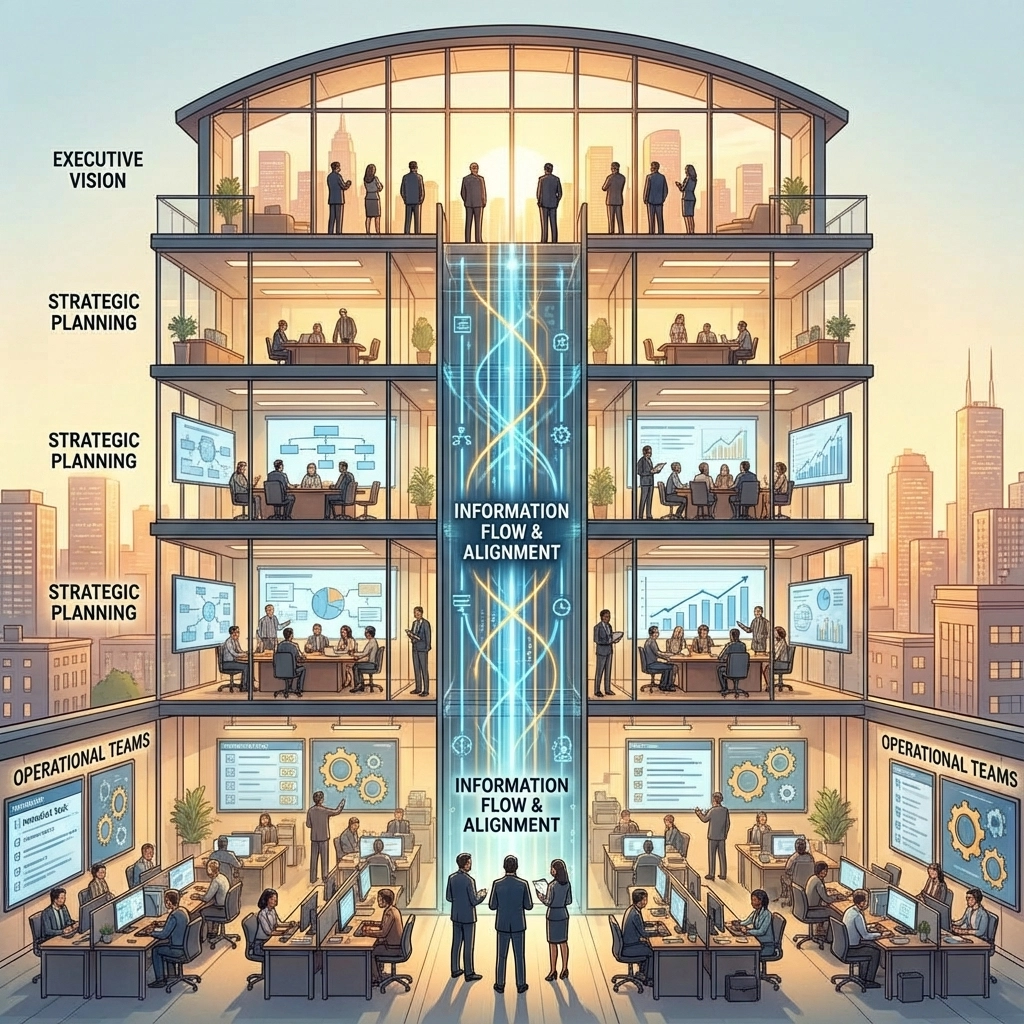
We begin with structured workshops involving key stakeholders across functions: not just leadership. These sessions identify genuine strategic priorities versus stated priorities. Often, there's a gap between what the executive team says matters and what the organization actually rewards and measures.
Our facilitation process uses frameworks like weighted scoring and impact-effort matrices, but the real value comes from getting different perspectives in the same room. When the head of operations explains why the "simple" CRM integration will actually take 8 months, it changes how leadership prioritizes initiatives.
Phase 2: Capability Mapping
We conduct detailed assessment of your current capabilities against strategic requirements. This isn't a traditional audit focused on compliance or best practices. It's specifically designed to identify the gap between what your strategy requires and what your organization can actually deliver.
For a professional services firm targeting enterprise clients, we identified that their project management capabilities were designed for smaller engagements. The roadmap needed to address process scaling and team development before pursuing larger opportunities: preventing future delivery failures.
Phase 3: Integrated Roadmap Development
The roadmap itself becomes a dynamic tool that balances competing priorities through explicit trade-off decisions. Rather than trying to do everything, it sequences initiatives based on strategic impact, operational feasibility, and resource availability.
Each roadmap element includes clear success metrics, resource requirements, and dependencies. Most importantly, it shows how tactical initiatives build toward strategic objectives over time.
Real-World Results: Manufacturing Case Study
A manufacturing client came to us with a classic alignment challenge. Their strategic goal was becoming a "data-driven organization" to improve operational efficiency and customer responsiveness. But their roadmap was a disconnected list of technology projects: ERP upgrade, business intelligence implementation, IoT sensor deployment.
Our aligned approach started with their immediate operational pain point: inability to predict equipment failures was causing costly unplanned downtime. We developed a roadmap that:
Month 1-3: Implemented basic predictive maintenance using existing sensor data
Month 4-8: Expanded data collection capabilities to support broader analytics
Month 9-18: Developed customer-facing visibility tools using the improved data infrastructure
The result? 23% reduction in unplanned downtime within six months, while building the data capabilities needed for their long-term strategic vision. Each tactical initiative delivered immediate value while advancing the broader transformation.

Common Alignment Pitfalls and Solutions
The "Everything is Priority One" Trap
When every initiative gets labeled as critical, nothing receives adequate focus or resources. We solve this through forced ranking exercises that require genuine trade-off decisions. If expanding into new markets is truly the top priority, what are you willing to delay or cancel to make resources available?
The "Perfect Information" Delay
Some organizations postpone roadmap decisions while gathering more market research, competitive analysis, or internal assessment. But roadmaps need to work with imperfect information while remaining adaptable as new data emerges.
Our approach builds flexibility through modular implementation phases and regular review cycles. You make the best decision possible with current information, then adjust based on actual results and changing conditions.
The "Sunk Cost" Continuation
Existing projects often continue simply because they're already started, even when strategic priorities have shifted. Effective roadmaps include explicit criteria for stopping or redirecting initiatives that no longer serve strategic objectives.
Building Organizational Alignment Beyond the Roadmap
The roadmap document itself is just the beginning. True alignment requires organizational changes in how decisions get made, how progress gets measured, and how teams collaborate across functions.
We work with clients to establish governance processes that keep the roadmap alive and relevant. This includes regular review cycles, clear escalation paths for trade-off decisions, and communication systems that keep all stakeholders informed about progress and changes.
Most importantly, we help organizations develop the internal capability to maintain alignment as market conditions and strategic priorities evolve. The goal isn't just creating one effective roadmap: it's building the muscle to continuously align execution with strategy.
Moving Forward: Your Next Steps
Effective roadmap alignment isn't about perfect planning: it's about creating dynamic tools that help your organization make better decisions under uncertainty while maintaining focus on what matters most.
If you're struggling to connect your strategic vision with operational reality, or if your team feels pulled in too many directions without clear priorities, it might be time to reassess your approach to roadmapping.
The most successful organizations we work with treat roadmap alignment as an ongoing capability rather than a one-time planning exercise. They build systems that help them navigate trade-offs, adapt to changing conditions, and maintain strategic focus even when immediate pressures demand attention.
Ready to explore how aligned roadmapping could transform your strategic execution? Let's discuss how your current initiatives connect to your long-term vision: and where the gaps might be creating unnecessary friction in your organization.