

VCM thought leadership
The Local Value Chain: Why UK Councils Need a Strategic Reset in 2026
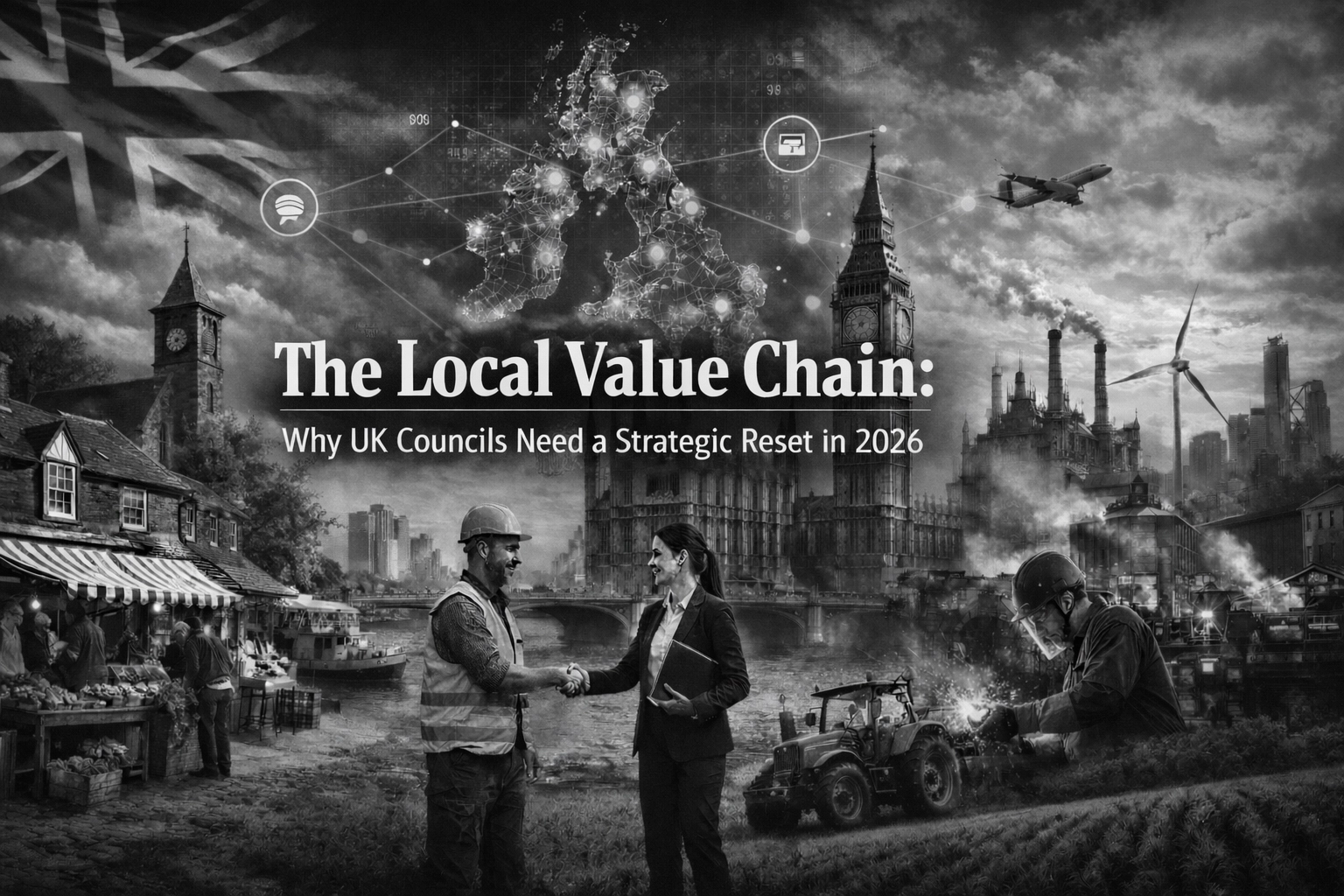
UK councils are facing a perfect storm. Funding pressures, structural reorganisation, and escalating resident expectations are colliding just as the government rolls out the most significant local authority reforms in a generation. For councils across the East of England: from Luton to Cambridge: 2026 isn't just another budget cycle. It's a strategic inflection point.
The question isn't whether councils can weather this storm. It's whether they have the strategic alignment and operational frameworks to come out stronger on the other side.
The Funding Puzzle: More Money, Less Certainty
Local government's Core Spending Power is projected to reach £77.7 billion in 2026-27. But the Fair Funding Review 2.0 changes the game: business rates redistribution, consolidated grants, and a bumpy transition that creates real uncertainty for councils trying to plan beyond the next 12 months.
Councils are also juggling council tax limits, business rates volatility, and new requirements like Extended Producer Responsibility (EPR). This isn’t just about money. It’s about strategic alignment: connecting income streams to service outcomes, resident needs, and long-term sustainability.
Growth Pressures: Infrastructure and the Circular Economy Gap
Across the East of England, growth keeps outpacing infrastructure: roads, schools, healthcare, and public transport are under strain. At the same time, EPR and wider waste reforms are a genuine circular economy opportunity—but many councils are still treating it as compliance, not transformation.
The practical issue is simple: without a joined-up value chain optimization lens, waste, procurement, planning, skills, and economic development stay in silos—and councils miss the chance to create local value while reducing long-term cost.
The Case for Local Leadership: Vested Interest Matters
The councils that perform best usually have leaders who genuinely understand local reality. Vested interest isn’t a conflict: it’s a competitive advantage. When leadership teams live the day-to-day issues: schools, transport, housing pressure: they spot second-order impacts earlier and make better calls.
Local businesses are also a critical part of the local value chain. This is where council business centres can help turn “noise” into practical, evidence-based insight and collaboration: skills, supply constraints, high streets, and resilient local procurement.
Why Local Employability Is Critical for Change
Big reform plans don’t land without people who can deliver them. That’s why employability matters: it reduces long-term demand pressure on crisis services, strengthens local suppliers, and builds capability so change becomes sustainable, not just compliance.
Why Overseas Private Equity Matters as a Short-Term Driver
Some outcomes take years, and residents feel the strain now. Aligned overseas Private Equity (PE) can accelerate delivery in housing, infrastructure-adjacent services, energy efficiency, and digital capability: as long as governance and data keep public value protected over the long term.
What Needs to Change: From Silos to Systems
The 2026 reset isn’t about doing more of the same. It’s about operating as a system:
Align services to outcomes across the full value chain (planning, care, waste, housing)
Use data for decisions, not just reporting
Integrate teams across functions, so delivery doesn’t get stuck in silos
Design around residents, not org charts
Choose long-term value, not short-term cuts that create bigger costs later
Why Value Chain Management? Connecting Strategy to Delivery
This is where Value Chain Management comes in. We're not offering councils another consultant report that sits on a shelf. We're providing the strategic alignment consulting frameworks that connect high-level strategy to operational delivery.
Our work with public and private sector organisations focuses on three core areas:
Mapping the Full Value Chain – Understanding how money, resources, and services flow through your organisation and where strategic misalignments create waste and poor outcomes.
Building Data Capability – Turning the data you already collect into strategic intelligence that drives better decisions at every level.
Creating Integrated Operating Models – Breaking down silos and building frameworks where different functions work as one coherent system focused on shared outcomes.
And specifically for council operations, we put extra emphasis on two things that often get missed when the pressure’s on:
Readiness to Change – Are your people, governance, comms, and delivery rhythms actually set up to absorb reform without stalling? We help you assess practical change capacity (not just produce a change plan) so teams can adopt new ways of working without burning out.
Scalability – How do you take what works in one service, one district, or one programme and scale it across the council (and partners) without creating a new mess? We help design operating models, data standards, and decision rights that scale cleanly across departments and place-based ecosystems.
For East of England councils facing the 2026 strategic reset, this isn't theoretical. It's practical support for navigating Fair Funding Review transitions, optimising EPR scheme implementation, and aligning growth plans with infrastructure capacity.
We're not magicians. We can't create money where none exists or solve decades of underinvestment overnight. But we can help councils make smarter decisions with the resources they have, align their organisations around what actually matters, and build the operational resilience needed for long-term success.
The 2026 Opportunity
UK councils don't need more pressure. They're already managing impossible trade-offs with inadequate resources. But 2026 also presents a genuine opportunity: a moment when funding reforms, structural reorganisation, and policy changes create space for strategic reinvention.
The councils that thrive won't be the ones that simply manage the transition. They'll be the ones that use it to fundamentally rethink how they create value for residents, how they allocate resources, and how they build organisational resilience.
The local value chain: connecting strategy, operations, and community outcomes: isn't just a framework. It's the foundation for councils that work. If your council is ready for that conversation, let's talk.
Writer Information

Name: Mustafa Khan
Job Title: Managing Partner
LinkedIn: in/mustafa-khan-9789195/
Phone: +44 779 5533 608